
1. What American odds actually are
American odds are the default odds format on every major US sportsbook - DraftKings, FanDuel, BetMGM, Caesars, and the rest all show you a plus or minus number next to a team, a player, or an outcome. That number does two jobs at once: it tells you which side is favored, and it tells you exactly how much you stand to win or need to risk.
The format gets its name simply because it's the standard in the United States, in the same way "decimal odds" are the standard across much of Europe, Australia and Canada, and "fractional odds" remain common in the UK. All three formats express the exact same underlying information - the probability the market assigns to an outcome - just written in different notation. If you only ever bet on US sportsbooks, you'll likely never need decimal or fractional odds, but understanding how they relate to American odds is useful, both for using an odds converter correctly and for spotting when a sportsbook's default display doesn't match a number you saw somewhere else.
Every American odds number is built around a simple $100 reference point, even though your actual bet almost never has to be $100. That reference point is the whole key to reading the format quickly once it clicks.
2. The core rule: plus and minus
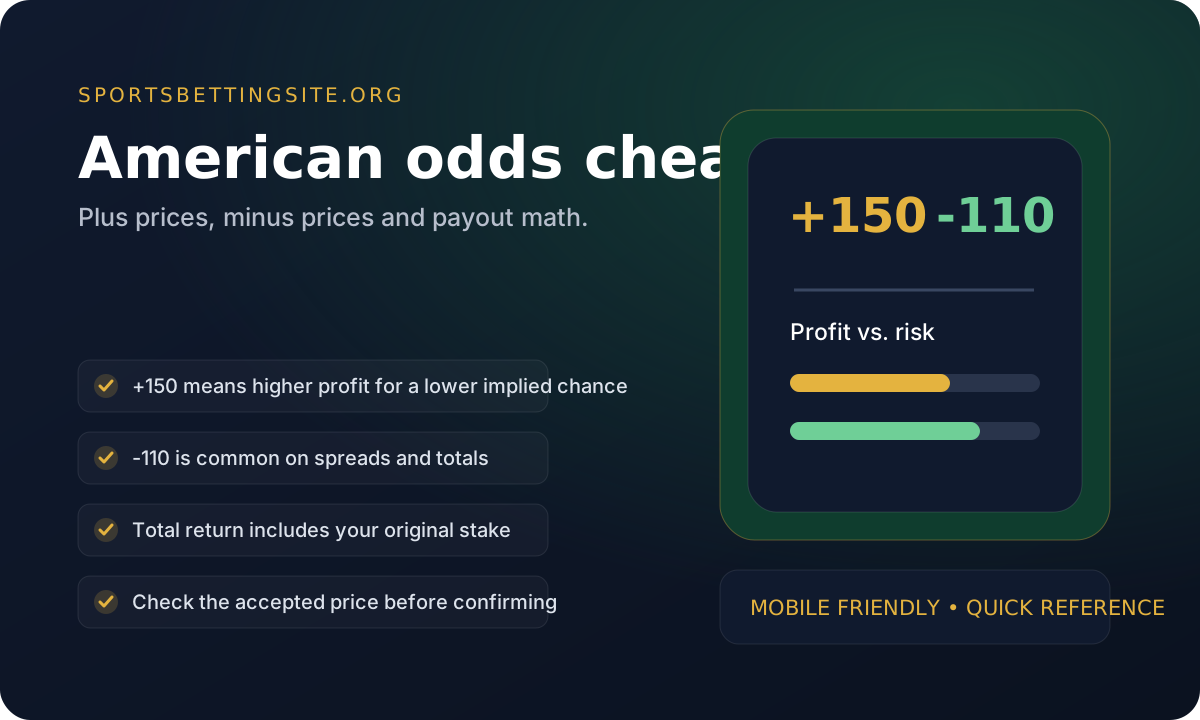
Every American odds number carries a sign. The sign tells you which side is favored before you even look at the size of the number.
Minus = favorite
The number shows how much you would need to risk to win $100 in profit.
Plus = underdog
The number shows how much profit you would win on a $100 stake.
The bigger the minus number, the heavier the favorite. The bigger the plus number, the bigger the underdog and the larger the payout relative to your stake.
3. Reading negative odds (the favorite)
Suppose the Kansas City Chiefs are listed at -165 to beat the Buffalo Bills. The minus sign tells you the Chiefs are favored. The number tells you that a $165 stake would win $100 in profit.
Chiefs -165
The larger the negative number becomes, the more heavily favored the side is considered and the worse the payout ratio becomes. That is why experienced bettors are often cautious with very heavy moneyline favorites: one upset can erase the profit from several earlier wins.
4. Reading positive odds (the underdog)
If the Buffalo Bills are listed at +140, the plus sign tells you they are the underdog. A $100 bet wins $140 in profit, for a $240 total return.
Bills +140
The bigger the positive number, the bigger the underdog and the larger the potential payout relative to your stake. Underdogs lose more often, but the payout structure means a bettor does not need to win a majority of those bets to be profitable.
5. Even odds and pick'em games
Occasionally you'll see a matchup listed as +100 (or sometimes written as "EVEN" or "PK" for pick'em) with no clear favorite. This means a $100 bet wins exactly $100 in profit - neither side is considered more likely than the other by the market.
Even odds show up most often in genuinely close matchups, or in markets where the sportsbook hasn't yet built in a house edge on one particular line (though this is rare - most books bake in their edge, called the vig, even on close matchups, which is covered in section 8).
It's worth noting that +100 and -100 represent the exact same payout ratio - risk $100 to win $100 - but sportsbooks will use whichever sign fits the context of how the line is being displayed. In practice, you'll see +100 far more often than -100, since a -100 line typically gets nudged slightly to one side or the other once the book's standard vig is applied.
6. Calculating payouts for any stake
The $100 reference point explains the format, but real wagers scale proportionally. These two formulas cover virtually every straight bet you will place with American odds.
Favorite payout formula
$50 at -165: $50 ÷ 1.65 = $30.30 profit. Total return = $80.30.
Underdog payout formula
$50 at +140: $50 × 1.40 = $70 profit. Total return = $120.
7. Converting odds to implied probability
American odds also encode an implied probability - the market's estimate of how likely an outcome is. Converting the price to a percentage lets you compare the book's number with your own estimate.
-165 becomes 165 ÷ 265 = 62.3%.
+140 becomes 100 ÷ 240 = 41.7%.
At +100, implied probability is exactly 50%. Larger negative numbers move the implied probability toward 100%; larger positive numbers move it toward 0%.
8. Why the numbers add up to more than 100%: the vig
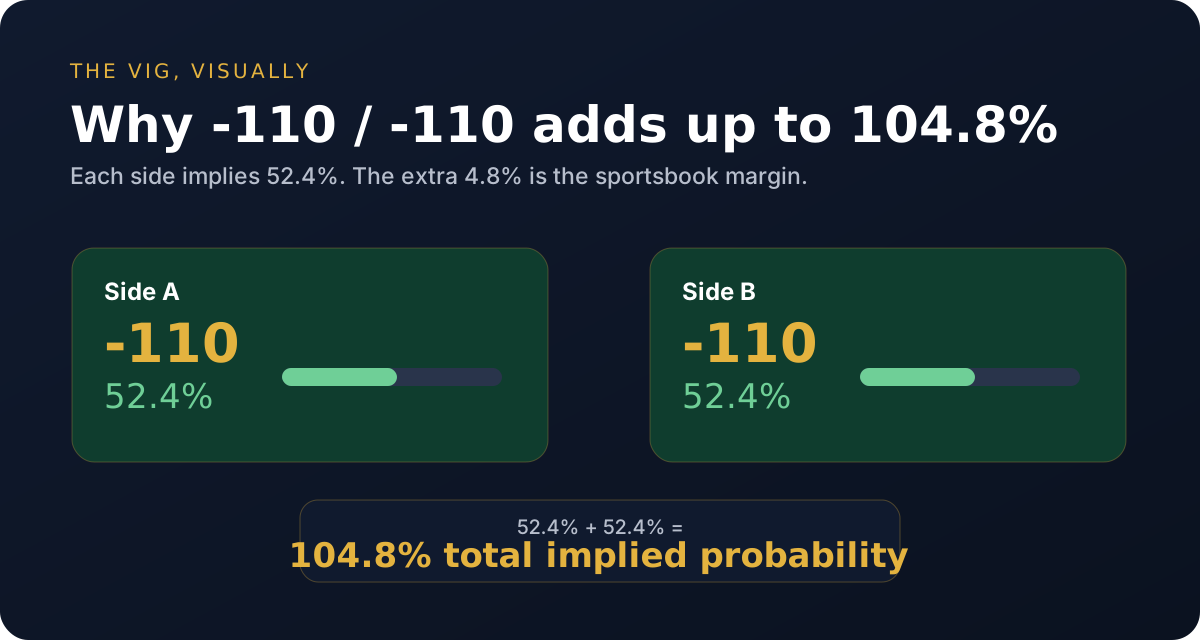
In a perfectly fair, no-profit betting market, the implied probabilities of all possible outcomes in a two-way market would add up to exactly 100%. In real sportsbook lines, they almost always add up to somewhere between 102% and 108%, depending on the sport, the market, and the specific book.
That extra percentage is called the vig (short for "vigorish") or the juice. It's the mechanism by which sportsbooks make money regardless of which side of a bet wins - by pricing both sides slightly worse than true 50/50 odds would suggest, the book guarantees itself a small edge on balanced action.
Standard spread and total bets in the NFL and NBA are usually both priced at -110, which corresponds to an implied probability of 52.4% per side - adding up to 104.8% combined, meaning the vig on a typical spread bet is roughly 4.8%. Moneyline vig varies more widely: tight, evenly matched games often carry vig similar to spread bets, while heavily lopsided matchups can carry noticeably more vig on the favorite's side specifically, since public bettors disproportionately like betting favorites and the book adjusts pricing accordingly.
Understanding the vig matters for two practical reasons. First, it explains why you can't simply bet both sides of a game and guarantee a profit - the math is built specifically to prevent that. Second, and more usefully, it explains why line shopping across multiple sportsbooks genuinely matters: two books offering the same game at -108 versus -110 might look nearly identical, but that small difference in vig compounds across a season of betting into a real, measurable difference in your results.
9. American odds vs. decimal odds vs. fractional odds
All three major odds formats express the same underlying probability. Only the notation changes.
| American | Decimal | Fractional | Implied probability |
|---|---|---|---|
| -165 | 1.61 | 20/33 | 62.3% |
| +140 | 2.40 | 7/5 | 41.7% |
| -110 | 1.91 | 10/11 | 52.4% |
| +100 | 2.00 | 1/1 | 50.0% |
| -300 | 1.33 | 1/3 | 75.0% |
| +250 | 3.50 | 5/2 | 28.6% |
| -500 | 1.20 | 1/5 | 83.3% |
| +600 | 7.00 | 6/1 | 14.3% |
American → decimal
Positive: (odds ÷ 100) + 1
Decimal → American
Below 2.00: -100 ÷ (decimal - 1)
10. How sportsbooks actually set the number
Understanding where an odds number comes from helps explain why it looks the way it does, and why it changes. Sportsbooks build an initial line - the "opening line" - using statistical models that estimate each side's true win probability, adjusted for matchup-specific factors like injuries, rest, home field advantage, and recent form. That model-driven estimate gets converted into American odds, then the sportsbook's standard vig gets layered on top of both sides.
From there, the number is only "final" in the sense that it's live and bettable - it's not fixed. As real money comes in on one side or the other, books adjust the odds to manage their own risk and keep action reasonably balanced between both sides of a bet. This means a line can move even when nothing about the actual matchup has changed; it's sometimes simply following where bettors are putting their money.
This is also why the number right before an event starts, called the closing line, is generally considered the sharpest and most information-rich odds a market produces - it's absorbed the most betting volume and the most last-minute news by the time it locks. Consistently getting a better number than the closing line ("beating the closing line") is considered one of the strongest indicators of long-term betting skill among serious, disciplined bettors.

11. Why odds move before a game starts
A handful of repeatable triggers move American odds between the opening line and game time.
Injury news
Star-player availability can move moneylines and spreads within minutes.
Lopsided betting action
Books may move a price to encourage action on the less popular side and manage exposure.
Weather
Wind, rain and temperature can shift totals in outdoor sports, especially football and baseball.
Lineup confirmations
Basketball lineups and baseball starting pitchers can cause late repricing.
Sharp money
Large bets from respected bettors can move a line even when overall public volume is modest.
Closing line
The final pregame number usually contains the most information and betting volume.
A move from -150 to -170 still follows the same plus/minus rules. Only the price and implied probability changed.
12. Reading a full betting line
On a sportsbook app, the spread, moneyline and total often appear side by side. The important distinction is that the spread or total number is not the odds price - the American odds sit next to it.
This distinction is one of the most common points of confusion for newer bettors, especially on mobile screens where the margin and price are displayed close together.
13. Using odds to shop for value across sportsbooks
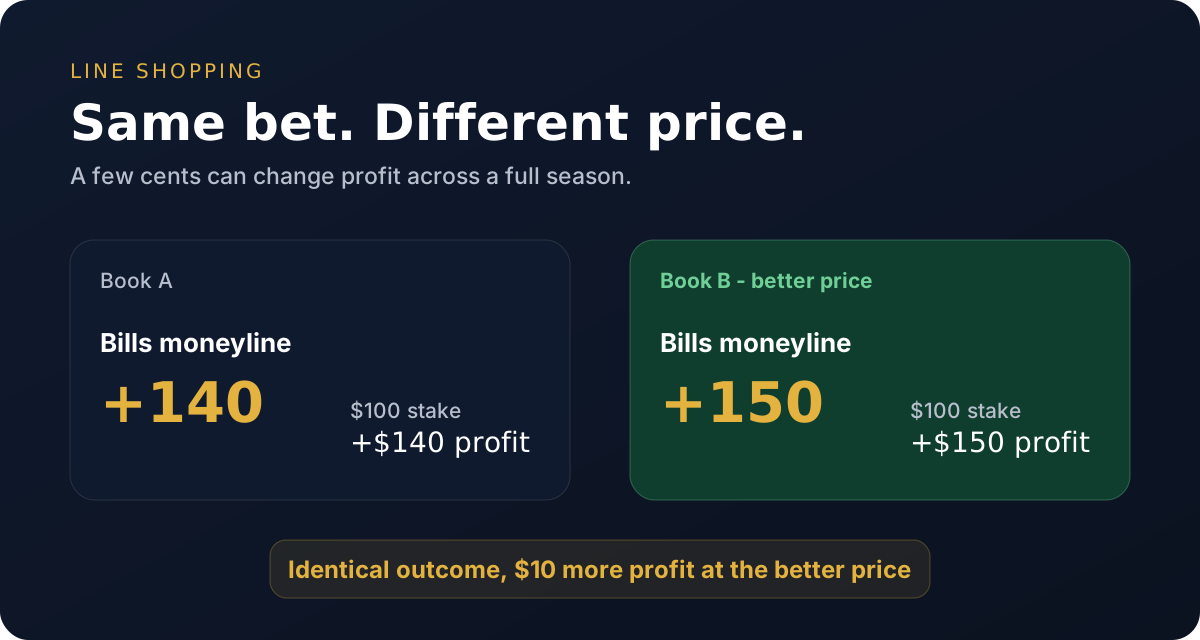
Because different sportsbooks build their own models and manage their own risk independently, the same game can be priced slightly differently from one book to the next. Comparing American odds across two or three sportsbooks before placing a bet - commonly called line shopping - is one of the simplest, most repeatable ways to improve your long-term results without changing anything about which bets you actually pick.
A small example makes the value concrete. Suppose Book A offers the Bills at +140, and Book B offers the same team at +150. On a $100 bet, that's the difference between $140 in profit and $150 in profit - a small gap on a single bet, but one that compounds meaningfully across dozens or hundreds of bets over a full season.
The same logic applies to spread and total pricing: a half-point of difference on a spread (say, -3 at one book versus -3.5 at another), combined with a few cents of difference in the odds themselves, adds up in ways that are easy to underestimate when you're only looking at one bet at a time. Serious bettors typically keep accounts open at two or three sportsbooks specifically to make this kind of comparison quick and easy before placing any single bet.
14. How odds differ by bet type
American odds apply to every market, but the price ranges you see depend on the bet type.
Spreads and totals
Usually cluster around -110 on each side because the point margin or total carries most of the matchup information.
Moneylines
Carry the widest range because there is no separate point spread absorbing the difference in team strength.
Player props
Often sit around -110 to -120 on simple two-way props, but extreme outcomes can be priced much longer.
Parlays and SGPs
Odds compound across legs. Three +100 legs do not become +300 - the combined price is much larger.
Futures
Long-term championship and award markets often carry large positive prices such as +1000 or more.
Alternate lines
Moving the point spread or total changes the American odds attached to the selection.
15. Worked examples, start to finish
Favorite: Dodgers -142
$40 stake → $28.17 profit → $68.17 total return. Implied probability: 58.7%.
Underdog: Bills +140
$25 stake → $35 profit → $60 total return. Implied probability: 41.7%.
Spread: Celtics -6.5 (-110)
$30 stake → $27.27 profit → $57.27 total return. The -6.5 is the margin, not the price.
Long shot: +650
$10 stake → $65 profit → $75 total return. Implied probability: 13.3%.
Book A -150 vs. Book B -140
A $100 stake profits $66.67 at -150 versus $71.43 at -140. Better price, same selection.
16. Common mistakes people make reading American odds
1. Bigger minus = automatically safer
A favorite is more likely to win, but the value of the price still matters.
2. Confusing the spread with the odds
-3.5 is a point margin; the -110 next to it is the American odds price.
3. Forgetting proportional scaling
+140 does not always mean exactly $140 profit. It means $1.40 profit per $1 wagered.
4. Ignoring implied probability
Converting a price to a percentage gives you a more objective way to judge it.
5. Adding parlay odds
Parlay prices compound; they do not simply add individual American odds numbers together.
6. Ignoring small price differences
Line shopping across sportsbooks is one of the simplest ways to improve long-run payout efficiency.
17. Frequently asked questions
18. Quick-reference glossary
Educational guide, not betting advice
Odds and examples are illustrative. Always confirm the live price and market details directly on the sportsbook before placing a wager, and keep betting within limits you can afford.