
Sports betting legislation doesn't only happen at the state level. In 2026, the single biggest story in the industry might be sitting inside the federal tax code, not a state capitol. A quiet provision buried in last year's sweeping tax package has changed the way the IRS treats gambling losses, and the fallout is now rippling through every corner of the legal sports betting market - from casual NFL bettors to full-time professional handicappers.
| Example | Before 2026 | 2026 rule |
|---|---|---|
| $100,000 winnings / $100,000 losses | $100,000 loss deduction | $90,000 loss deduction |
| Taxable gambling income in example | $0 | $10,000 |
| Maximum documented loss offset | 100% of losses, up to winnings | 90% of documented losses |
If you bet on sports in the United States, understanding this change matters just as much as knowing which sportsbook has the best odds boost. Here's a complete breakdown of what happened, why it's controversial, and where the fight to reverse it stands heading into football season.
How Gambling Losses Used to Be Taxed
For nearly seven decades, the federal tax code treated gambling winnings and losses in a fairly straightforward way. Under Section 165(d) of the tax code, a gambler who itemized deductions could write off 100% of their documented losses, up to the amount of their winnings, in a given tax year.
In practice, that meant a bettor who won $20,000 over the course of a year and lost $20,000 chasing those wins would report zero net gambling income. They broke even in real life, and the tax code reflected that reality. This "wash" treatment was considered fair because gambling, unlike most other income sources, involves constant back-and-forth wagering rather than a single clean transaction.
What Changed on January 1, 2026
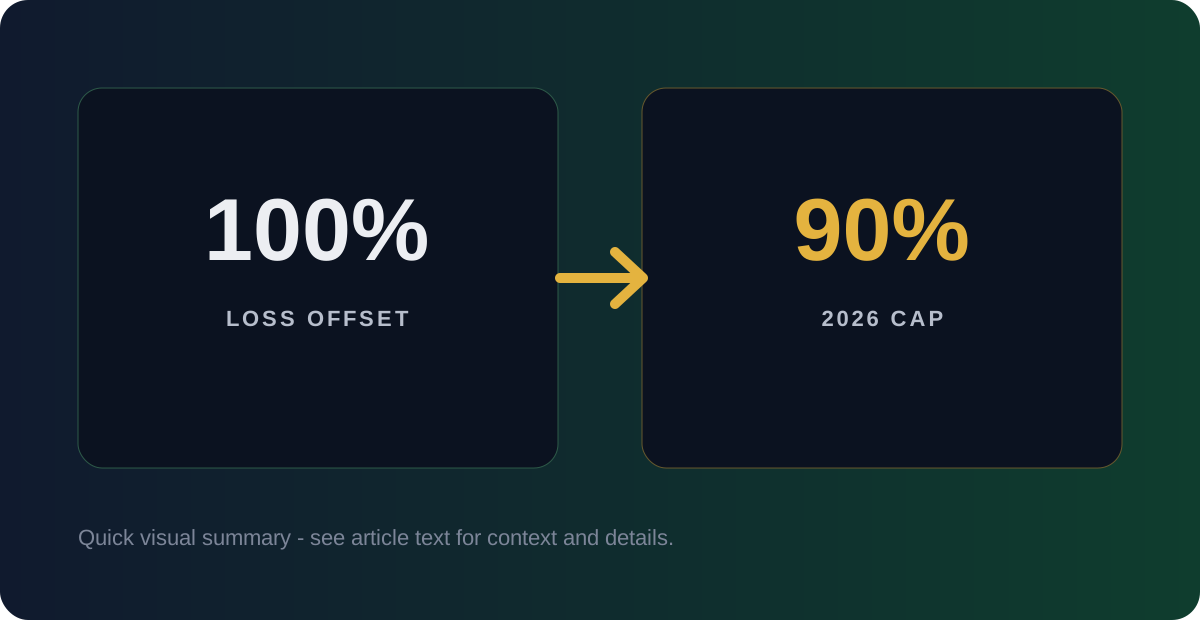
That changed when the One Big Beautiful Bill Act (OBBBA) took full effect at the start of this year. The legislation capped the gambling loss deduction at 90% of documented losses instead of 100%. On paper, a 10-percentage-point cut sounds minor. In practice, it creates what tax professionals and industry advocates have started calling "phantom income" - taxable income that doesn't correspond to any money the bettor actually took home.
Here's a simplified example that illustrates the problem. Imagine a bettor wins $100,000 over the course of a year and loses $100,000 chasing bets, ending the year exactly where they started financially. Under the old rule, they could deduct the full $100,000 in losses against their $100,000 in winnings and owe no gambling-related tax. Under the new 90% cap, they can only deduct $90,000. The remaining $10,000 becomes taxable income, even though the bettor didn't actually gain a dollar.
The math gets far more dramatic for high-volume and professional bettors, whose winnings and losses can run into the millions of dollars over a season. A professional gambler with $20 million in winnings and $18 million in losses would, under the new rule, be taxed on $3.8 million of income instead of $2 million - a difference that can turn a profitable year into a break-even or losing one once the tax bill arrives. The Joint Committee on Taxation has estimated the provision will generate roughly $1.1 billion in additional federal tax revenue, largely by taxing this kind of phantom income rather than genuine profit.
Why the Industry Is Fighting Back
It didn't take long for the sports betting industry, tax professionals, and lawmakers from gaming-heavy states to sound the alarm. The core argument from opponents of the 90% cap is straightforward: if the tax code makes it more expensive to gamble legally, bettors - especially high-volume and professional players - will migrate to offshore, unregulated sportsbooks that don't report winnings to the IRS at all. That outcome would be worse for everyone, the argument goes, since it strips away consumer protections, state tax revenue, and problem-gambling safeguards that come with regulated, licensed operators.
The American Gaming Association has been especially vocal, framing the 90% cap as a threat to the legal market that could push serious bettors back toward black-market operators. Their position is that a policy meant to raise a modest amount of federal revenue could end up shrinking the legal, taxed, regulated betting economy that states have spent years building since the 2018 repeal of PASPA.
Congress Responds: The FAIR BET Act
Representative Dina Titus of Nevada, whose district includes the Las Vegas Strip, has emerged as the leading voice in Congress pushing to reverse the change. She introduced the Fair Accounting for Income Realized from Betting Earnings Taxation Act - better known as the FAIR BET Act - aimed at restoring the full 100% deduction for gambling losses.
The bill picked up genuine bipartisan interest, a rarity in the current Congress, reflecting how gambling tax policy tends to cut across party lines in states with large gaming economies. Titus attempted to attach the FAIR BET Act as an amendment to the 2026 National Defense Authorization Act, a common legislative strategy for riding a smaller bill on the back of must-pass legislation. That effort was blocked by the House Rules Committee, leaving the bill stalled in the House Ways and Means Committee as of mid-2026.
Undeterred, Titus has since filed a discharge petition, a procedural tool that can force a bill out of committee and onto the House floor for a vote even without leadership support, provided enough members sign on. Whether that effort succeeds before the end of the year remains one of the more closely watched storylines in gaming policy circles.
The FULL HOUSE Act: A Second Legislative Track
The FAIR BET Act isn't the only bill aiming to undo the 90% cap. A companion effort, the FULL HOUSE Act, has also been introduced with bipartisan sponsorship and is specifically designed to repeal the loss-deduction cap and restore the tax code to its pre-2026 treatment of wagering losses. Industry watchers note that having two separate bipartisan vehicles moving through Congress - even if neither has passed yet - signals real appetite for a fix, even though the legislative calendar and competing priorities have so far kept either bill from reaching a floor vote.
Some prediction market platforms have even listed contracts on the odds of the deduction cap being repealed before the end of the year, an unusual but telling sign of how closely the betting industry itself is tracking the outcome of this fight.
What This Means for Bettors Right Now
Until Congress acts, the 90% deduction cap remains the law for the 2026 tax year. That has practical implications for anyone who bets regularly and itemizes deductions:
- Recordkeeping matters more than ever. The IRS does not accept a sportsbook's win/loss statement alone as sufficient proof of losses; those statements typically include disclaimers noting they're estimates. Tax professionals recommend keeping a contemporaneous log of wagers, along with supporting documentation like bank statements, deposit and withdrawal records, and betting slips.
- High-volume bettors should talk to a tax professional. The gap between old and new treatment grows with bet volume, so anyone wagering large sums regularly - even while roughly breaking even - could see a meaningfully larger tax bill this year.
- Group winnings need special handling. For bettors who split a large jackpot or parlay win with others, IRS Form 5754 allows the tax liability on a single W-2G to be divided among multiple winners, which can help avoid one person being taxed on money that was actually distributed to a group.
- State tax treatment is separate. Some states have their own rules around gambling loss deductions that are independent of federal law, so bettors should check their individual state's tax code as well.
How the 90% Cap Compares to Past Gambling Tax Debates
This isn't the first time federal gambling taxation has become a flashpoint, but tax professionals note that the structure of this particular change is unusual. Most prior gambling tax controversies centered on reporting thresholds - for instance, debates over the $600 W-2G trigger for slot machine jackpots, which many in the industry have separately argued is outdated given inflation since it was set decades ago. The 90% deduction cap is different because it doesn't just change when winnings get reported; it changes the fundamental math of what counts as taxable income in the first place, even for a bettor who never had a profitable year.
That distinction is part of why the FAIR BET Act and FULL HOUSE Act have found support well beyond the usual pro-gambling lobbying circles. Tax attorneys and CPAs who work with recreational and professional gamblers alike have pointed out that phantom income taxation is a genuinely unusual concept in the broader tax code - most income categories don't tax people on money they demonstrably never kept.
Which Bettors Are Affected Most
Not every sports bettor will feel the 90% cap equally. The people most exposed to this change share a few characteristics:
- High-volume bettors and "sharps" who place large numbers of wagers and operate on thin margins are disproportionately affected, since the gap between the old and new deduction rules widens as total wagering volume grows, even if net profit stays flat.
- Professional gamblers who file as self-employed face a double impact, since the cap applies on top of already complex self-employment tax treatment for gambling-related income.
- Casual bettors who itemize deductions rather than taking the standard deduction are the only group who can claim the loss deduction at all, meaning bettors who don't itemize won't see any change from this provision, but also weren't benefiting from the prior 100% deduction to begin with.
- Bettors in states with their own gambling loss deduction rules may see a smaller net effect if their state tax code doesn't mirror the new federal 90% cap, underscoring why checking state-specific treatment matters alongside the federal picture.
The Political Path Forward
Because both the FAIR BET Act and the FULL HOUSE Act carry bipartisan sponsorship, most observers in Washington see the eventual outcome as a question of legislative vehicle and timing rather than ideological opposition. The most likely paths forward include attaching a fix to a future must-pass spending bill, a broader tax extenders package, or a standalone vote forced by Representative Titus's discharge petition if it gathers enough signatures. Industry lobbyists have signaled they expect the issue to remain a live topic through the rest of the 2026 legislative calendar, particularly as tax filing season approaches in early 2027 and the real-world impact of the 90% cap becomes clearer in actual filed returns rather than hypothetical examples.
The Bigger Picture
This fight over Section 165(d) is really a proxy for a larger question the sports betting industry has been wrestling with since legalization began spreading state by state after 2018: how much regulatory and tax burden can the legal market absorb before bettors start looking for alternatives outside the system? Every new tax, fee, or restriction imposed on licensed sportsbooks and their customers changes that calculation slightly, and the 90% deduction cap is one of the more consequential examples to emerge at the federal level.
Whether the FAIR BET Act, the FULL HOUSE Act, or some combination of the two eventually reaches President Trump's desk will likely depend on whether lawmakers can find a must-pass legislative vehicle to attach a fix to before political attention moves elsewhere. For now, bettors filing 2026 tax returns should plan for the 90% cap to apply, keep detailed records of their activity, and watch for updates as the discharge petition and committee process continue to play out in Washington.
Frequently Asked Questions
Does the 90% cap apply to casual bettors, or just professional gamblers? It applies to anyone who itemizes deductions and claims gambling losses against gambling winnings on their federal return, regardless of whether they gamble casually or professionally. The dollar impact simply scales with how much a person wins and loses over the year.
Do I need to itemize to be affected by this change? Yes. Bettors who take the standard deduction rather than itemizing were never able to deduct gambling losses in the first place, so the 90% cap only changes outcomes for filers who itemize.
Is this the same as the separate debate over lowering the $600 W-2G reporting threshold? No. The W-2G reporting threshold determines when a sportsbook or casino must report a jackpot-style win to the IRS. The 90% deduction cap is a separate provision governing how much of a bettor's total annual losses can offset their total annual winnings.
Could the 90% cap still be repealed before the 2026 tax filing deadline? It's possible but not guaranteed. Both the FAIR BET Act and FULL HOUSE Act remain active in Congress, and either could theoretically be attached to a must-pass bill before the end of the year. Bettors should plan around current law while watching for updates rather than assuming a repeal will happen in time.
Always gamble responsibly and within your means. If you or someone you know has a gambling problem, help is available by calling or texting 1-800-GAMBLER.