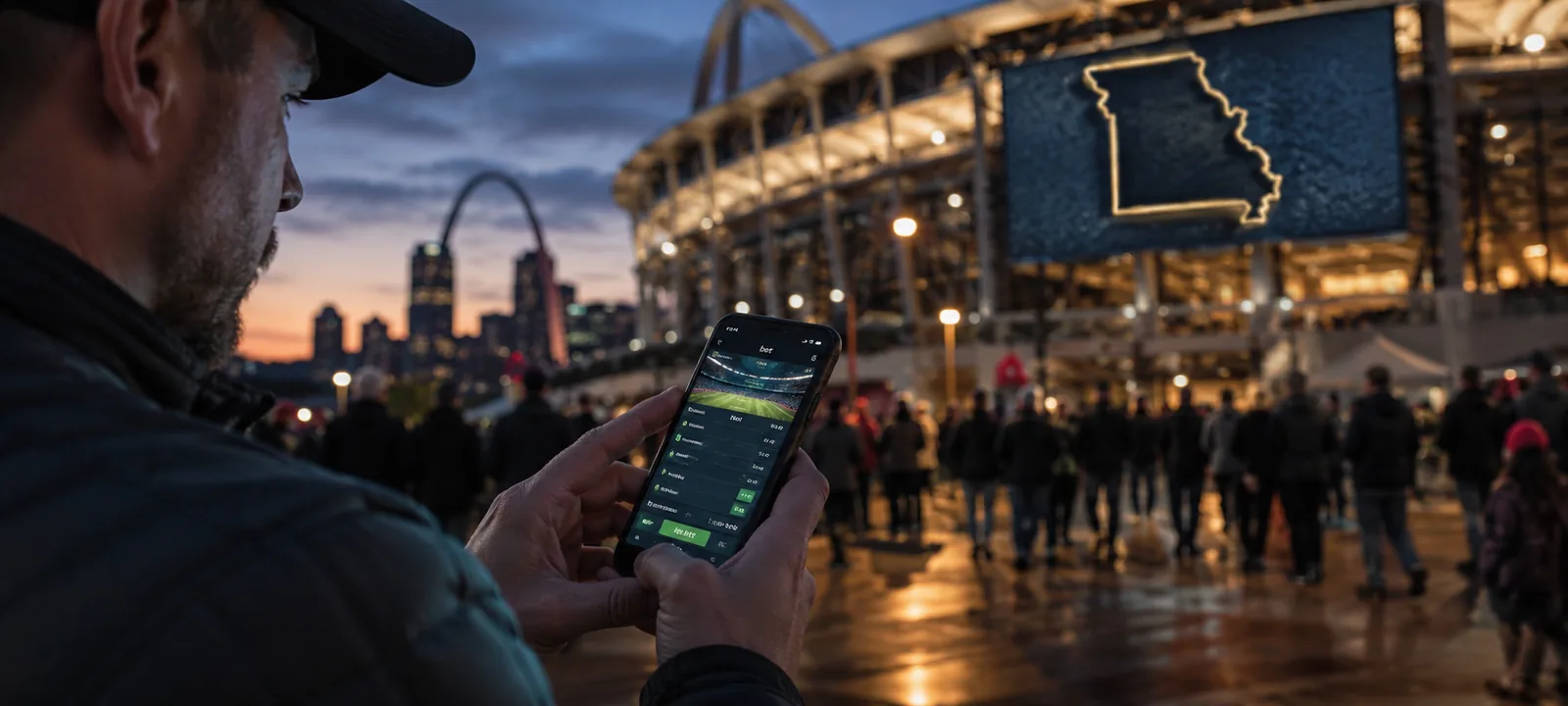
When Missouri sports betting officially went live at midnight on December 1, 2025, it marked the end of a long and occasionally contentious road to legalization - and the beginning of one of the more closely watched market launches in recent memory. Nearly a year removed from that first bet, Missouri's rollout offers a useful case study in how modern sports betting markets launch, compete, and mature. Here's a full look back at how Missouri got here and where the market stands today.
| Milestone | Detail |
|---|---|
| Voter approval | Amendment 2 approved in November 2024 |
| Market launch | December 1, 2025 |
| License framework | Up to 33 retail and mobile licenses |
| Untethered licenses | DraftKings and Circa Sports |
| Opening field | Roughly ten approved sportsbooks on day one |
The Road to Legalization
Missouri's path to legal sports betting was longer and bumpier than many of its neighboring states. Voters narrowly approved Amendment 2 in November 2024, legalizing both online and retail sports wagering, with the measure passing by just over 50% of the vote. The law officially took effect on December 5, 2024, making Missouri the 39th state to legalize sports betting since the Supreme Court struck down the federal PASPA ban in 2018.
What followed was a lengthy regulatory buildout. The Missouri Gaming Commission spent much of 2025 establishing rules, tax structures, and licensing procedures before the market could open. An attempt to speed up the process through emergency rulemaking was rejected by Missouri's Secretary of State, pushing the timeline back and ultimately leading regulators to formally set December 1, 2025, as the market's go-live date. For comparison, neighboring Kansas legalized sports betting in May 2022 and had its market live by that September - a far faster turnaround that highlights just how much variation exists state to state in how quickly a legal framework translates into an actual, functioning market.
The Missouri Gaming Commission began accepting operator license applications in May 2025, with a September 12 postmark deadline for mobile license submissions. Nine operators applied ahead of that deadline, setting the stage for one of the more competitive opening days any new state has seen.
Licensing Structure: Untethered vs. Tethered Operators
Amendment 2 allows for up to 33 total sports betting licenses across retail and mobile platforms, split between two license types. "Untethered" licenses allow an operator to run a sportsbook in the state without needing to partner with an existing casino or professional sports franchise, while other operators must secure market access through partnerships with in-state casinos or sports teams.
DraftKings and Circa Sports were the only two operators awarded untethered licenses, giving them the ability to launch independently. Every other major operator had to strike a partnership to gain entry. BetMGM partnered with Century Casinos to secure its access. FanDuel partnered with St. Louis City SC of Major League Soccer. Other operators aligned with riverboat casinos and professional venues across the state to satisfy the partnership requirement.
Launch Day: December 1, 2025
Missouri's launch day brought together an unusually deep field of operators right out of the gate. DraftKings, FanDuel, BetMGM, Caesars, bet365, and Fanatics all went live simultaneously, alongside Circa Sports and several smaller platforms, giving the state roughly ten approved sportsbooks on day one - a notably more crowded opening field than many prior state launches.
Pre-registration had opened on November 17, 2025, allowing bettors to create accounts, make deposits, and lock in welcome offers before wagering officially began. Collectively, the six major operators offered an estimated $5,500-plus in combined promotional value to attract early sign-ups, ranging from bonus-bet matches to deposit-match offers and no-sweat first bets.
Timing mattered here as much as the offers themselves. Missouri's launch landed squarely in the middle of the NFL and college football seasons, and it also overlapped with the start of the NHL season - a scheduling choice that maximized the amount of bettable content available to new users from day one. Fittingly, the first mobile wager placed on Caesars Sportsbook in the state was a five-leg NHL moneyline parlay, underscoring just how quickly bettors dove into the newly legal market once it opened.

How the Market Has Evolved Since Launch
In the months following the December launch, Missouri's operator lineup has continued to grow. As of August 2026, the state has issued eight mobile sports betting licenses, with room under Amendment 2's cap for additional operators to enter the market over time. Regulators moved operators from temporary to full licensure status as part of the standard post-launch review process, a routine step most new markets go through in their first several months of operation.
Beyond traditional sportsbook wagering, Missouri bettors also have access to daily fantasy sports contests, including pick'em-style products, as well as horse racing wagering - reflecting the broader menu of legal betting products that has become standard in most mature US markets.
What Missouri's Launch Teaches Us About the Modern Market
Missouri's rollout is instructive for a few reasons that go beyond the state's own borders.
First, it illustrates just how much more competitive new-market launches have become compared to the early post-PASPA years. When New Jersey launched the first legal online sportsbook outside Nevada back in 2018, it did so with a relative handful of operators and modest promotional offers by today's standards. Missouri's ten-book, $5,500-plus opening day is a reflection of how mature and well-capitalized the industry has become, with national operators now treating every new state launch as a major customer-acquisition event.
Second, Missouri shows how much the regulatory buildout phase - not the legislative vote - has become the real bottleneck for new markets. Missouri's roughly 13-month gap between legalization taking effect and the market actually opening is now fairly typical, as gaming commissions balance the pressure to launch quickly against the need to build a durable licensing, taxation, and compliance framework from scratch.
Third, the state's mix of untethered and tethered licenses reflects a broader trend in how newer states are structuring their markets: opening the door to major national operators like DraftKings and Circa without requiring a casino partnership, while still preserving in-state economic partnerships for operators like BetMGM, FanDuel, and Caesars through professional sports teams and existing casino operators.
Comparing Missouri to Other Recent State Launches
Missouri's launch stands out in a few specific ways when measured against other recent state debuts. Where some states have opened with just two or three operators live on day one, gradually approving additional sportsbooks over subsequent months, Missouri opted for a wider initial field of roughly ten approved books. That decision reflects a broader industry shift: as more states have gone through the legalization-to-launch process, gaming commissions have increasingly favored bigger, more competitive opening fields, betting that more operator competition on day one drives stronger promotional offers and a better overall experience for bettors, even if it adds complexity to the regulatory review process leading up to launch.
The timing of Missouri's launch also mattered strategically. December 1 placed the market's debut in the heart of the NFL and college football regular seasons, while also catching the start of the NHL season and the ramp-up toward NBA and college basketball's biggest stretches. Some earlier state launches happened during comparatively quieter periods on the sports calendar, which can blunt initial betting volume even when promotional offers are strong. Missouri's late-fall timing gave bettors an unusually dense slate of bettable events from the very first day the market opened.
The Tax and Revenue Picture
Amendment 2 set Missouri's sports betting tax structure as part of the ballot measure itself, a detail that had been a major sticking point during years of failed prior legalization attempts in the state legislature. Disagreements over the appropriate tax rate on operator revenue were one of the central reasons Missouri lagged behind neighboring states like Kansas and Illinois in legalizing sports betting in the first place, despite years of legislative attempts. Now that the market is operational, state officials and industry analysts are watching early tax revenue figures closely, both to assess how Missouri's rate compares to peer states and to gauge whether the eventual full-scale rollout of all available licenses will meaningfully increase the state's take from the market over time.
Lessons for Bettors in Still-Unlaunched States
For residents of states that have legalized sports betting but haven't yet launched, such as Wisconsin, Missouri's experience offers a reasonably reliable preview of what to expect. Pre-registration periods that open several weeks before the official launch date have become standard practice, often accompanied by the biggest promotional offers a bettor will see from a given operator, since these periods are specifically designed to build the largest possible base of registered users before wagering even begins. Bettors in states awaiting their own launch should watch for similar pre-registration windows, keep an eye on which operators have secured licenses well in advance of a go-live date, and expect that the biggest-name national operators will typically be ready to launch on day one rather than trickling in gradually, based on the pattern Missouri and other recent launches have established.
What's Next for Missouri
With its first NFL and college football season as a fully legal market now underway, Missouri's sports betting industry is heading into what regulators and operators alike consider its true first full-scale test: sustained football-season betting volume across an entire fall slate, rather than the holiday-season ramp-up that defined its opening weeks. Additional mobile licenses remain available under Amendment 2's framework, meaning bettors could see further operators enter the market in the months ahead as the state's gaming commission continues processing applications.
For a state that spent years navigating disagreements over tax rates and regulatory oversight before voters finally approved Amendment 2, Missouri's first year offers a case study in both the opportunities and growing pains that come with standing up a modern, competitive sports betting market from scratch - one that other still-unlaunched states are almost certainly watching closely.
The Broader Significance for the Industry
Missouri's launch carries significance beyond its own borders for one simple reason: it was the only state to legalize and launch a new sports betting market in all of 2025, giving the entire industry a single, closely watched case study for what a modern launch looks like under current market conditions. Operators, regulators, and lobbying groups in other states now weighing legalization have Missouri's rollout as a fresh reference point - from how license types were structured, to how promotional spending played out, to how quickly the market moved from voter approval to an actual functioning sportsbook ecosystem.
That reference point matters most for states still working through their own legalization or launch process. Wisconsin regulators finalizing rules for their state's mobile launch, for instance, are operating in an environment shaped partly by what Missouri and other recent state launches have already demonstrated works well and what creates friction. The same applies to states like Georgia and Texas, where legalization advocates frequently point to recently launched markets like Missouri as evidence of the tax revenue and consumer interest a well-run legal market can generate relatively quickly once it's up and running.
Early Signs of Market Maturity
Nearly a year into operation, a few signs point to Missouri settling into a more mature phase of market development, following the pattern seen in most other recent state launches. The shift from temporary to full operator licensure, additional mobile licenses being processed and issued, and a full football season now underway as a legal market all mark a transition away from the launch-phase promotional blitz and toward the kind of steady-state competitive landscape seen in longer-established markets like New Jersey, Pennsylvania, and Illinois. How Missouri's total handle and tax revenue figures compare to those established markets over its first full year will likely become one of the more closely tracked data points in the industry as 2026 progresses.
Frequently Asked Questions
Which sportsbooks are currently live in Missouri? As of August 2026, licensed operators include DraftKings, FanDuel, BetMGM, Caesars, bet365, Fanatics, and Circa Sports, among others, with eight mobile licenses issued so far and additional capacity remaining under Amendment 2.
Is retail (in-person) sports betting also available in Missouri? Yes. Amendment 2 legalized both mobile and retail wagering, and retail sportsbooks tied to riverboat casinos and professional sports venues launched alongside the state's mobile platforms on December 1, 2025.
How old do you have to be to bet on sports in Missouri? Bettors must be 21 or older and physically located within Missouri's state lines at the time of placing a wager, consistent with standard requirements across nearly all legal US sports betting states.
What other legal wagering options exist in Missouri besides traditional sportsbooks? Missouri bettors also have access to daily fantasy sports platforms, including pick'em-style contests, as well as licensed horse racing wagering, both of which predate the state's traditional sports betting legalization.
Always gamble responsibly and within your means. If you or someone you know has a gambling problem, help is available by calling or texting 1-800-GAMBLER.