If there's one storyline that has dominated US sports betting news more than any state legalization bill in 2026, it's the escalating legal battle between traditional, state-licensed sportsbooks and a new breed of competitor: federally regulated prediction markets like Kalshi and Polymarket. What started as a niche corner of the crypto and finance world has exploded into a nationwide courtroom fight over who actually gets to regulate sports wagering in America - and the outcome could reshape the entire industry.
| Feature | Prediction market | Traditional sportsbook |
|---|---|---|
| Primary regulator described in article | Federal CFTC framework | State gaming commissions |
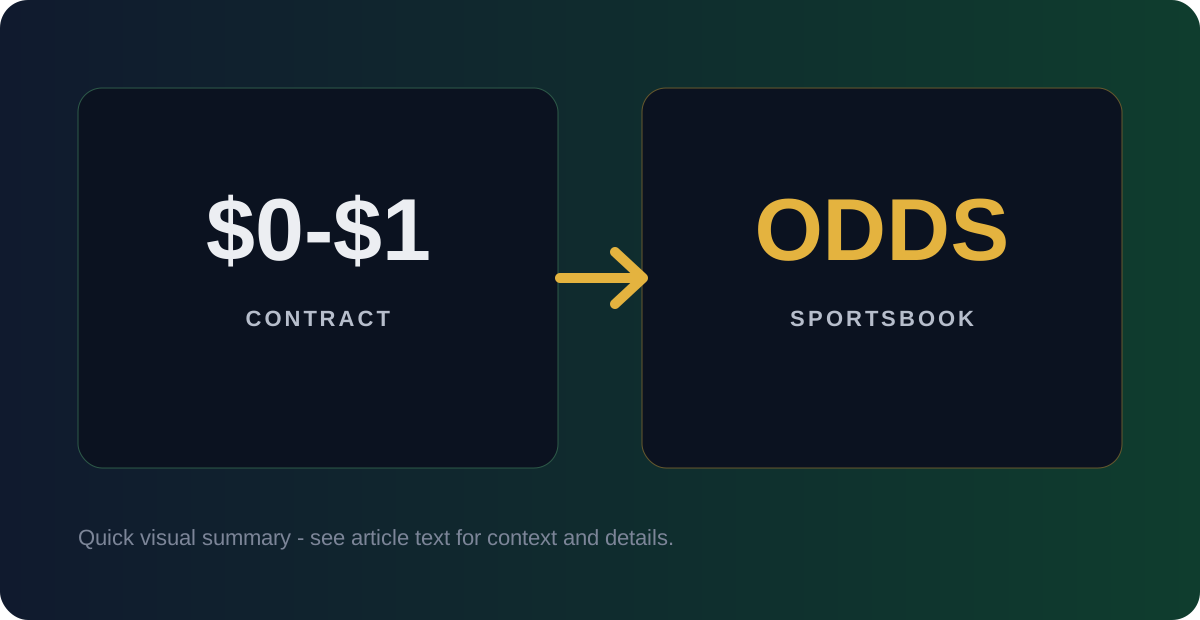
| Price format | Contracts priced between $0 and $1 | Moneyline, spread, total and prop odds |
| Typical operator cost | Trading fees and bid-ask spread | Vig or juice embedded in odds |
| Market access dispute | Potential nationwide federal model | State-by-state licensing |
Here's what every sports bettor should understand about prediction markets, why states are suing to shut them down, and where the fight currently stands.
What Are Prediction Markets, and How Are They Different From Sportsbooks?
Prediction markets like Kalshi and the US version of Polymarket allow users to buy and sell contracts based on the outcome of future events - everything from elections and economic data releases to, increasingly, sports games. A user might buy a "contract" that pays out $1 if a team wins and $0 if they lose, with the contract's price fluctuating based on demand, similar to a stock or futures market.
The critical distinction platforms like Kalshi draw is regulatory: they are licensed and overseen by the Commodity Futures Trading Commission (CFTC), a federal agency that regulates derivatives and commodities markets, not by state gaming commissions. That federal designation is the entire foundation of their legal argument - and the entire source of the conflict.
Traditional sportsbooks like DraftKings, FanDuel, BetMGM, and Caesars, by contrast, are licensed on a state-by-state basis, pay state gaming taxes, and operate only in states that have specifically legalized sports betting. A sports prediction contract on Kalshi, functionally, can look nearly identical to a moneyline or point-spread wager at a licensed sportsbook - the difference is almost entirely regulatory and structural rather than experiential for the end user.
How the Conflict Started
Kalshi's rise didn't begin with sports. The company first made headlines by winning a major legal battle against the CFTC itself, successfully arguing that election-outcome contracts did not constitute illegal gambling under the Commodity Exchange Act. That victory, which allowed Kalshi to process well over a billion dollars in election-related trades, established the legal template the company would later apply to sports.
In early 2025, Kalshi expanded into sports-related event contracts, letting users trade on the outcomes of major events including March Madness and the Super Bowl - critically, in states where traditional sports betting was not even legal. That move triggered immediate pushback. Six states where sports betting was already legal, including Nevada, New Jersey, Illinois, Maryland, Ohio, and Montana, sent Kalshi cease-and-desist letters, arguing the company was offering unlicensed sports betting under a different name and without paying the state gaming taxes that licensed operators pay.
Kalshi's response was blunt. CEO Tarek Mansour argued publicly that state gaming law simply didn't apply to a federally regulated exchange, and the company went on the legal offensive, suing states like New Jersey and Nevada to block their enforcement actions before those states could shut the platform down.
The Lawsuits Multiply in 2026
What began as a handful of cease-and-desist letters has since grown into a sprawling, multi-front legal war involving state attorneys general, tribal gaming authorities, private plaintiffs, and the CFTC itself.
New York became one of the most prominent battlegrounds when Attorney General Letitia James filed suit against Kalshi, alleging the platform was running an unlicensed illegal gambling operation. The lawsuit specifically cited Kalshi's sports contracts as violating state laws that prohibit betting on games involving New York college teams and that restrict sports wagering to users 21 and older. The suit sought not just an order forcing Kalshi to submit to state licensing and taxation, but also the forfeiture of what the state described as billions of dollars in allegedly illegal profits. Kalshi's public response framed the lawsuit as political theater, warning that shutting the platform out of New York would simply push bettors toward unregulated offshore alternatives instead.
The CFTC didn't stay on the sidelines. In response to New York's suit, the federal commission filed an emergency motion seeking to block the state from applying its gambling laws to Kalshi at all, arguing that doing so amounted to regulatory overreach into an area of exclusive federal jurisdiction.
Arizona took an even more aggressive approach, with Attorney General Kris Mayes filing criminal misdemeanor charges against Kalshi, accusing the company of operating an illegal gambling business and of unlawfully accepting bets on Arizona elections, including a wager on the 2028 presidential race. Kalshi had actually sued Arizona first, seeking a declaration that it could legally operate in the state; the state's criminal charges followed shortly after. A federal judge ultimately granted the CFTC a temporary restraining order and permanently blocked Arizona from pursuing the criminal case, though appeals in that matter remain ongoing.
Massachusetts, meanwhile, became one of the first states where a court sided with regulators rather than Kalshi. A Suffolk County judge ruled that Kalshi's sports event contracts were subject to the state's gaming laws and issued a preliminary injunction barring the platform from allowing Massachusetts users to place sports-related trades.
Rhode Island added both Kalshi and Polymarket to the list of defendants, with its attorney general arguing that both platforms were operating illegal gaming businesses that undercut the state's own regulated sports betting and lottery systems.
By mid-2026, a coalition of 44 state attorneys general had formally weighed in, sending a letter to the CFTC as part of a public comment period arguing that the commission has no authority to regulate sports-related event contracts in the first place - a direct challenge to the entire legal theory Kalshi has built its sports betting expansion on.
Why the Gaming Industry Is Pushing Back Hard
The traditional gaming industry hasn't stayed quiet either. The American Gaming Association, which represents licensed casino and sportsbook operators, has publicly applauded state enforcement actions against Kalshi, framing the fight as one of basic fairness and rule of law. The organization has pointed to the tens of thousands of jobs supported by the licensed gaming industry in states like New York, arguing that allowing an unlicensed, untaxed competitor to offer functionally identical sports wagering products undermines the entire regulatory framework states have built since PASPA's repeal.
The stakes here extend well beyond Kalshi and Polymarket. Legal analysts tracking the litigation note that the outcome could set a precedent affecting any company that tries to offer sports-adjacent financial products under federal commodities law rather than state gambling law. If Kalshi's theory prevails in the courts, it could open the door to a nationwide, single-regulator model for sports-related wagering - the "one rulebook instead of fifty" outcome the company has said it's aiming for. If states prevail instead, prediction markets offering sports contracts could be forced into the same state-by-state licensing and tax structure that traditional sportsbooks already operate under, and the business model as currently constructed could become far more complicated to sustain.
How Prediction Market Odds Actually Work for Bettors
For users encountering platforms like Kalshi for the first time, the trading-based structure can feel unfamiliar compared to a traditional sportsbook. Instead of a fixed moneyline or point spread set by an oddsmaker, contract prices on prediction markets move continuously based on buy and sell activity from other users, similar to how a stock price moves on an exchange. A contract trading at 60 cents implies the market currently views that outcome as roughly a 60% probability; buying it costs 60 cents with a potential payout of $1 if correct.
This structure changes how bettors think about value. On a traditional sportsbook, the "vig" or "juice" built into the odds represents the operator's built-in margin, and it's typically consistent and disclosed as part of the odds themselves. On a prediction market, the effective cost of trading comes through the bid-ask spread and any trading fees the platform charges, which can vary by contract and by how much liquidity exists in a given market at a given moment. Sports bettors accustomed to shopping for the best line across multiple sportsbooks have had to learn an entirely new set of tools and instincts to evaluate whether a prediction market contract represents good value compared to an equivalent bet at a licensed sportsbook.
The Consumer Protection Debate
Beyond the jurisdictional fight, state regulators have raised a second, related concern: consumer protection standards. Licensed sportsbooks operating under state gaming law are typically required to offer specific responsible gambling tools, including self-exclusion programs, deposit and time limits, and mandatory funding of state-level problem gambling resources. States suing Kalshi and Polymarket have argued that prediction markets, regulated instead under commodities law, aren't subject to the same state-mandated consumer protection framework, even though the sports contracts they offer can look and function almost identically to a sportsbook wager from a user's perspective.
Kalshi has pushed back on this characterization, pointing to its own voluntary responsible trading tools and arguing that federal CFTC oversight provides its own robust regulatory framework, just one built around commodities trading standards rather than state gambling standards. Legal scholars watching the litigation have noted that this consumer protection argument, separate from the pure jurisdictional question, could end up playing a meaningful role in how courts and eventually Congress resolve the broader dispute, since it touches on policy goals - like preventing underage access and problem gambling - that exist somewhat independently of which regulator technically has authority.
What Happens if Congress Steps In
Given how many separate lawsuits, state actions, and CFTC counter-filings are currently working their way through the court system, some industry observers believe the cleanest resolution to this conflict may ultimately come from Congress rather than the judiciary. A federal law explicitly defining which sports-related contracts fall under CFTC jurisdiction versus state gambling law could resolve the current patchwork far more quickly than dozens of individual state court cases working through appeals over a period of years. Momentum in this direction has already started to build: Representative Josh Gottheimer has been pushing legislative efforts requiring prediction markets and online sportsbooks alike to verify user eligibility more rigorously, while other lawmakers have floated broader legislation specifically addressing how prediction markets should be regulated going forward. Major gaming industry associations, tribal gaming representatives, and labor unions have also formally asked Congress to include prediction market restrictions in other pending legislation, signaling that this fight is increasingly being waged on Capitol Hill as well as in courtrooms.
Where Things Stand as of August 2026
As of this writing, Kalshi and the Polymarket US app remain technically live and operating nationwide under their CFTC licenses, but a growing patchwork of states have taken action to restrict or contest that access, particularly around sports-related contracts. Bettors should expect this list to keep shifting as court rulings, injunctions, and appeals continue to move through the system in the months ahead - what's permitted in one state today may not be permitted tomorrow, and vice versa.
For everyday sports bettors, the practical takeaway is to always confirm the current legal status of any prediction market platform in their specific state before participating, given how quickly the legal landscape is changing. For the industry as a whole, this fight over jurisdiction may end up being one of the most consequential regulatory battles in the history of legal sports wagering in the United States - arguably rivaling the 2018 PASPA repeal itself in terms of how much it could reshape who is allowed to take a sports bet, and under what rules.
Frequently Asked Questions
Is it currently legal to trade sports contracts on Kalshi or Polymarket? The legal status varies significantly by state and continues to change as lawsuits progress. Both platforms hold federal CFTC licenses and describe themselves as legal nationwide, but a growing number of states dispute that position for sports-related contracts specifically, and some have obtained injunctions restricting access. Always check current state-specific status before participating.
Are prediction markets the same thing as sports betting? Functionally, sports-related prediction market contracts can look very similar to traditional wagers, but they operate under a different legal and regulatory structure - federal commodities law rather than state gambling law - which is precisely the point of contention driving the current litigation.
Why are state attorneys general so focused on this issue? States argue that allowing an unlicensed, untaxed alternative to operate alongside their regulated sportsbook markets undermines consumer protections, tax revenue, and the licensing framework built since 2018, while also potentially enabling access in states where sports betting isn't legal at all.
Could this dispute eventually get resolved by the Supreme Court? It's possible. Given the number of active federal court cases and the fundamental jurisdictional question involved, some legal analysts believe this conflict could eventually require Supreme Court review or a clarifying act of Congress to fully resolve.
Always gamble responsibly and within your means. If you or someone you know has a gambling problem, help is available by calling or texting 1-800-GAMBLER.