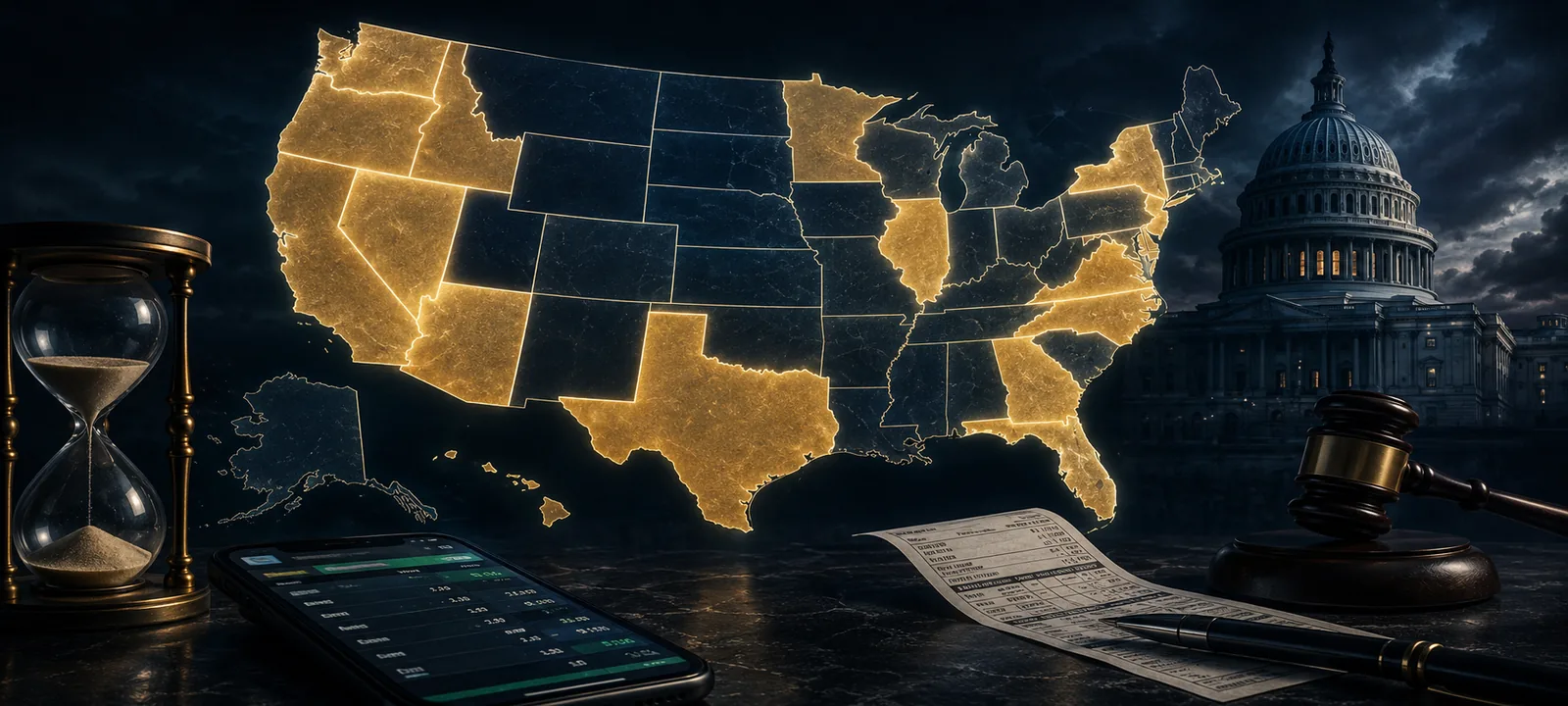
For most of the past seven years, the story of US sports betting has been one of steady expansion - a new state going live almost every few months since the Supreme Court struck down the federal ban in 2018. In 2026, that story has largely paused. Missouri's December 2025 launch may end up being the last new legal market for some time.
An analyst's blunt prediction
Heading into 2026, at least one Wall Street gaming analyst put the odds of any new state approving sports betting or iGaming this year at effectively zero. The reasoning wasn't pessimism so much as pattern recognition: legislative sessions move slowly, the states most likely to act have largely already acted, and the remaining holdouts each carry their own specific, stubborn obstacle - a required constitutional amendment, entrenched tribal gaming interests, or a legislature that has repeatedly failed to find the votes even when a bill gets close.
That pattern held through most of 2025 as well: North Carolina's legalization came down to the wire, Illinois rewrote its tax structure in the final hours of a budget session, and even Missouri - a state widely expected to pass sports betting - barely cleared the threshold needed. Legislative unpredictability, not lack of industry interest, has been the real constraint.
Where the remaining holdouts stand
- California: The largest state without legal sports betting. A costly, unsuccessful 2022 ballot initiative soured both the industry and tribal gaming interests on another near-term attempt; tribes are reportedly laying groundwork for a fresh ballot push in 2028 rather than 2026.
- Texas: Two competing constitutional amendments have been introduced that would let the legislature authorize sports and casino wagering, but any change still requires statewide voter approval - a multi-year process even if a bill clears the legislature.
- Alabama: Came one vote short of legalization in 2024; a 2026 bill died without ever getting a committee hearing.
- Alaska: A bill authorizing statewide mobile wagering with a 12% tax carried over without a floor vote; even if it eventually passes, any resulting market wouldn't launch until 2027 at the earliest.
- Mississippi: A mobile wagering bill tied to funding the state's public pension system remains pending, alongside a separate bill aimed at cracking down on unregulated sweepstakes-style gambling products.
- Hawaii: Legislation nearly passed in the prior session and returned in 2026, proposing at least six licenses with a 15% tax on revenue - still pending as of this writing.
- Oklahoma: Multiple legislative efforts over several years have failed to pass both chambers; sports betting remains illegal in the state as of September 2026.
Could prediction markets change the calculus?
There's early speculation that the rapid growth of prediction markets - which operate under federal rather than state gambling licenses and have already expanded into states without legal sports betting - could pressure more state legislatures to revisit legalization, simply to bring betting activity that's already happening back under state licensing and tax structures.
Whether that pressure actually moves any holdout state remains an open question. Prediction markets are also the subject of an active legal fight between operators, state gaming regulators and federal commodities regulators over who has jurisdiction in the first place - a dispute that could either accelerate state-level legalization arguments or get resolved in a way that keeps prediction markets in their own separate regulatory lane entirely.
What it means for bettors
For bettors in states that already have legal sports betting, the 2026 standstill changes very little day to day. For bettors in holdout states, the realistic timeline for legal, regulated access hasn't meaningfully shortened this year - most of the paths forward (a constitutional amendment in Texas, a ballot initiative in California, a legislative supermajority in Alabama) require multiple years and multiple election cycles to play out, even under optimistic assumptions. The more immediate story in 2026 hasn't been which states are joining the map, but how aggressively the states already on it are adjusting tax rates and betting rules within markets that already exist.
Frequently Asked Questions
Most states most likely to legalize already have. The states still on the board tend to face bigger structural obstacles, such as tribal-gaming negotiations, constitutional questions, or repeated legislative deadlock.
Not necessarily. Existing markets can still grow, but expansion into brand-new states appears to be moving more slowly than in prior years.
Watch for ballot activity, compact negotiations, court fights, and renewed statehouse debates. Those are the developments most likely to change the map.